We replaced fragmented point-to-point connections with a global UNS architecture.

We built a reproducible site blueprint using Ignition, Cirrus Link, TimescaleDB, and Grafana.
We scaled the standardised data foundation across 6 plants in 17 months, with more on the way.

From a local flax cooperative to a global manufacturing leader with 35 production sites, Unilin has a long history of innovation. As their footprint expanded, their IT/OT infrastructure grew plant by plant. Each facility developed custom tools, resulting in a fragmented landscape with point-to-point connections, various connectivity stacks, and unsupported legacy components. Without a shared reference integration architecture, data models remained isolated and lacked data ownership beyond the individual plant level.
Unilin launched their OT Horizon initiative to resolve this fragmentation and build a scalable data foundation. They defined three clear architectural rules: the framework had to be open and extensible, use replaceable components that prevent vendor lock-in, and avoid best-of-breed dogmatism. Unilin brought us on board as their co-creation and implementation partner to define a global IT/OT blueprint and guide their multi-site rollout.


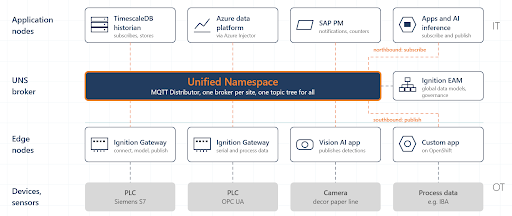
Together with Unilin, we designed a standardised, event-driven Unified Namespace (UNS) architecture with a single publish-subscribe data hub per site. The reproducible blueprint allows plants to publish operational data once and make it instantly available to any local or central consumer.
Using this identical site architecture, Unilin scaled the new data foundation from their pilot plant to 6 live production facilities across Belgium, France, and Luxembourg in just 17 months. The platform gives Unilin a proven high-velocity model as they continue rolling out the blueprint across the rest of their 35 global plants.

We partnered with


Fueled by


Throughout this ongoing project, one word was key for the way we cooperate: co-creation. We built on their ambitious OT Horizon initiative and internal guidelines to design a data architecture and integrated platform that fits who they are and what they do.
As part of their OT Horizon strategy, Unilin organised workshops across their three business units. What stood out to us is that they established a scoring matrix based on their own criteria, not on vendor promises. Key factors included European support availability, transparent pricing, and usability for plant teams.
After evaluating technologies, Unilin selected the Ignition platform combined with Cirrus Link MQTT modules, TimescaleDB, and Grafana. This stack was familiar to their plant OT teams, had clear pricing, and offered flexible scripting capabilities rather than restricting them to a low-code interface.
Together, we designed a site architecture that can be deployed identically across every plant.
At the plant level, an Ignition Site Gateway connects southbound to field devices, including Siemens S7-1500 PLCs, using OPC UA and native drivers. The gateway formats the incoming data and publishes it to a local Cirrus Link Distributor MQTT broker.
Time-series data is written straight to a TimescaleDB database through Ignition’s Tag Historian. For central cloud analytics, the Cirrus Link Azure Injector streams real-time data directly into Unilin's central Azure Data Platform.
At the group level, a central Ignition Controller Gateway uses the Enterprise Administration Module (EAM). This allows Unilin to manage all site gateways and distribute global data models from a single hub.
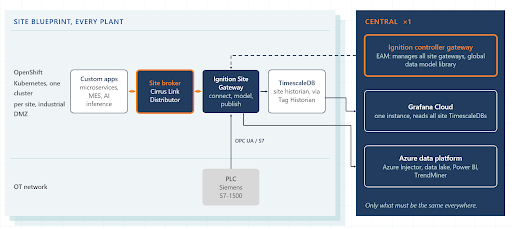
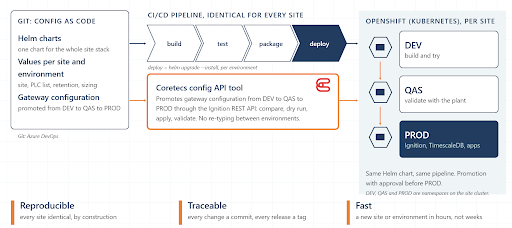
Configuring gateways manually across 35 plants was simply not an option if Unilin wanted to scale fast. So, we containerised the site software stack and deployed it on an on-premise OpenShift cluster in each plant's industrial DMZ.
We packaged the entire site architecture into Helm charts and managed all configurations in Git using Azure DevOps CI/CD pipelines. To promote gateway configurations across namespaces, we developed a custom Config API tool that interacts directly with the Ignition REST API to compare, dry-run, apply, and validate configurations automatically. This eliminates manual re-typing and makes every site deployment completely reproducible.
A Unified Namespace requires strict data governance. Without clear rules, messaging structures can quickly become disordered, and consistency was one of the main drivers for Unilin to undertake this project in the first place.
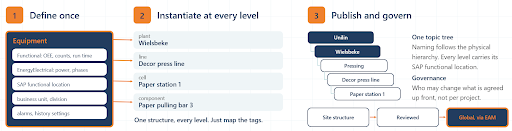
To keep things consistent, we modelled data structures in Ignition using User Defined Types (UDTs). The topic tree follows a clear physical ISA-95 hierarchy: Plant, Line, Cell, and Component. Every level in the topic tree includes its corresponding SAP Functional Location.
Unilin also introduced a Plant UNS Engineer role at each facility. This person owns the local data tree and works directly with central IT and OT teams to keep structures aligned.
As previously stated, this project is still ongoing and will be rolled out to more sites and countries. However, Unilin’s new architecture already made a noticeable impact on the shop floor. The following use cases were made possible by the standardised data foundation.
PLC counter values map directly to asset UDTs on the Unified Namespace. The platform automatically creates measurement points and triggers maintenance notifications in SAP PM.
On decor paper pressing lines, custom vision AI apps run on the local OpenShift cluster. The AI combines camera feeds with UNS process context to detect paper tears and automatically stops the press, reducing scrap and downtime.
Operators use live time-series trending in Grafana to prepare glue just-in-time for order changes. Once built on the UNS, Unilin replicated this use case to additional presses in a matter of days.
The system contextualises data for every board across the manufacturing process. This lays the groundwork for detailed defect analysis and real-time process steering.
Ready to replace point-to-point connections with a scalable architecture? Our experts will help you build a future-proof data strategy for multi-site operations that matches how you operate.