
Build a secure manufacturing data infrastructure using an integrated platform ecosystem.

Enforce unified namespace governance and automated schema validation across all sites.
Connect your edge operations directly to conversational AI agent workflows.

Litmus is an industrial data and edge platform built to bridge the gap between your shopfloor environments and enterprise IT systems at scale. Instead of forcing you to piece together fragmented software components, Litmus provides a fully integrated ecosystem designed to handle the entire lifecycle of industrial metadata.
The platform relies on five core pillars: Litmus Edge for local device connectivity, Litmus Edge Manager for global device orchestration, Litmus Unify to construct a governed Unified Namespace (UNS), Litmus Data Catalog for metadata lineage and quality tracking, and Litmus MCP Server to provide a standardised natural language interface for AI applications.


We typically recommend Litmus for multi-site rollouts where enterprise-wide standardisation is the main goal. Because the ecosystem handles the entire data lifecycle, we can use it to build repeatable architectures across different factories. This reduces manual configuration overhead and saves lots of setup time. Stacking Litmus Edge instances across segmented network layers also makes it our go-to choice for strict security environments looking to achieve compliance with NIS2 or IEC 62443 standards.
Once that network foundation is secure, we layer Litmus Unify and the Data Catalog on top to lock down your Unified Namespace governance and stop data models from drifting. We rely on the platform’s Edge Manager to push custom Docker applications, time-series databases, and machine learning models straight to the machine layer. Finally, by implementing the open-source MCP Server, we turn standard conversational text into live edge queries, granting your data scientists and AI agents direct access to field telemetry without needing custom scripts.
Need to scale your industrial data strategy across multiple sites? Here is why you should consider Litmus for enterprise rollouts.
No need to worry about the specific mix of legacy and modern equipment on your shop floor. Litmus Edge comes with over 250 pre-built drivers, connecting everything from Siemens PLCs to older Modbus devices effortlessly.
If you prefer a best-of-breed setup instead of Litmus’ best-of-suite approach, Litmus Edge also connects to your SCADA, MES, data historian, and other tools.
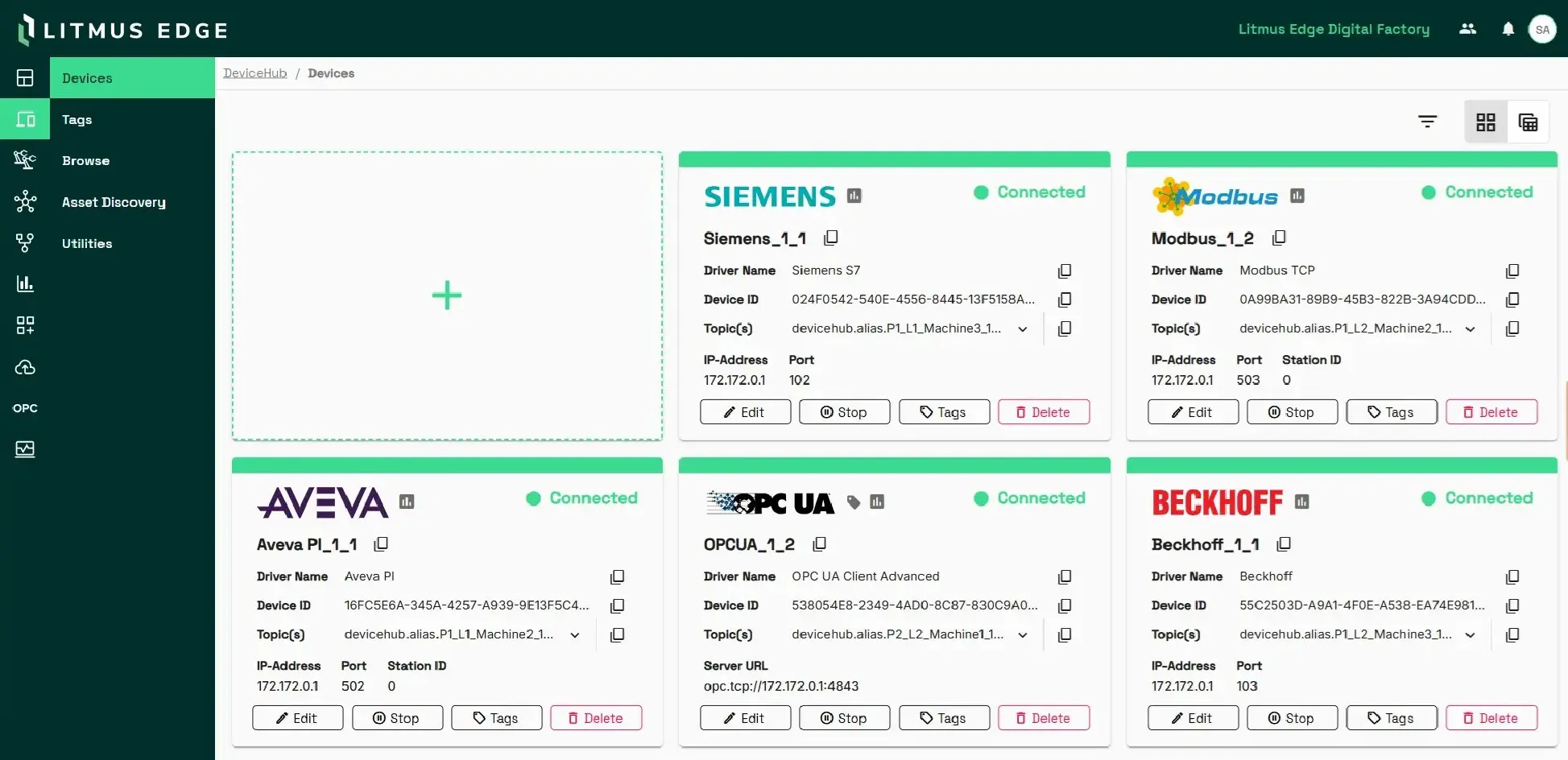
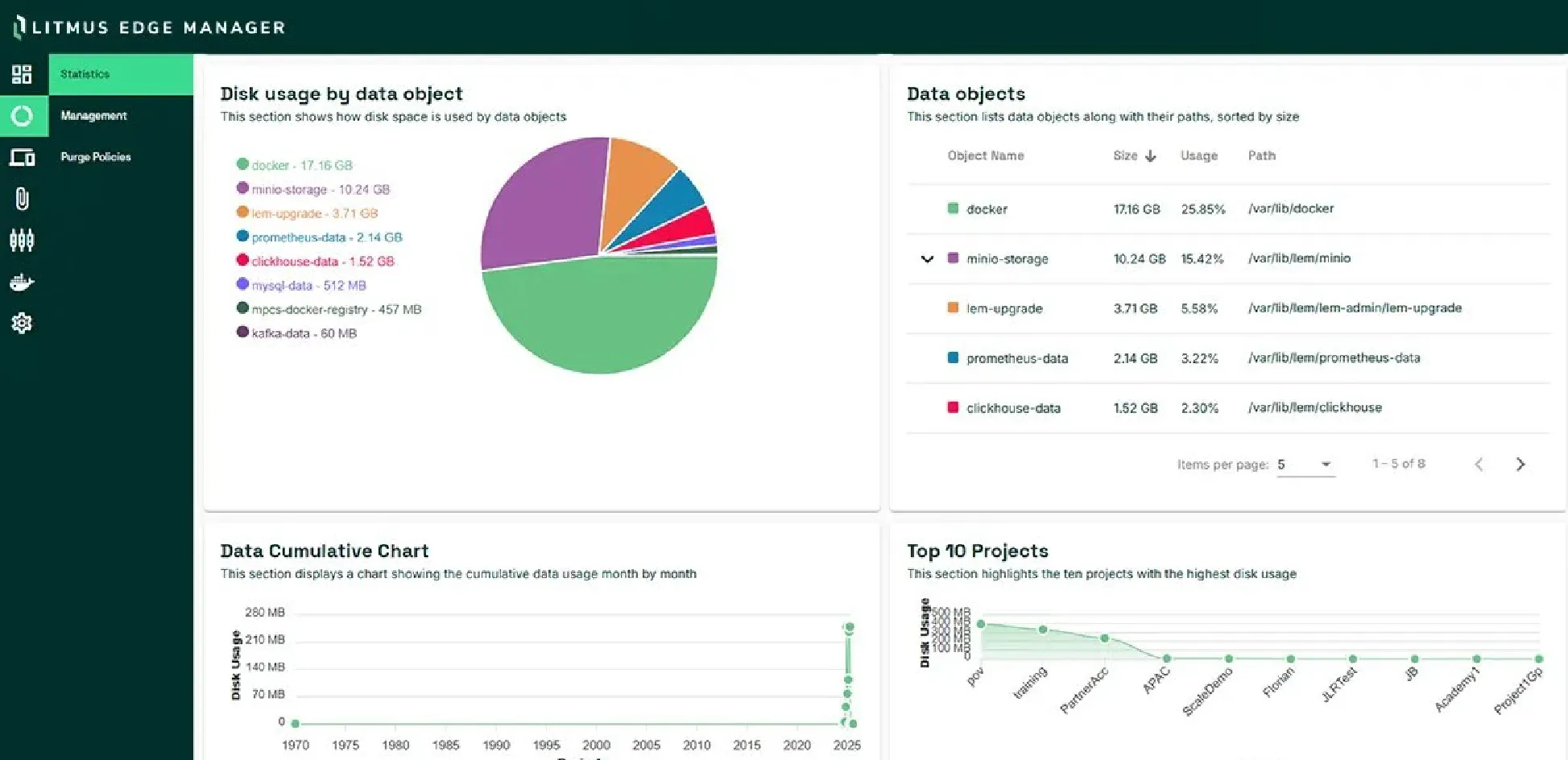
Setting up one node is easy, but rolling out an architecture across multiple factories can quickly become a headache. One of the reasons why Litmus works so well at an enterprise scale is its Edge Manager. This gives you a single pane of glass to control all your devices, data, and applications.
You can use Edge Manager to standardise deployments via templates and push updates over the air. This saves hours of manual on-site maintenance. Its built-in container support also lets you deploy and manage containerised Docker applications like Grafana dashboards, InfluxDB and Timescale right where the data is generated.
We love building modular, best-of-breed architectures, but there's a strong case for an all-in-one approach if you want to avoid vendor sprawl. Litmus Unify is an optional add-on that creates a governed data layer over your pub/sub infrastructure.
It enforces consistent namespace rules, tag templates, and payload standards, running automated schema validation before any data point reaches your enterprise broker.

When your enterprise metrics don't match the reality on your shop floor, your teams will quickly lose trust in their analytics. Litmus Data Catalog maps your complete end-to-end lineage from the physical PLC directly to the cloud.
It automatically detects schema drift and structural alterations, flagging data quality issues before they skew your corporate reporting.

Do you engineers lose lots of time switching dashboards, searching for hidden tags, or writing custom troubleshooting scripts? Litmus MCP Server introduces a conversational layer over your edge network.
This allows both human operators and AI agents to query live telemetry, check historical context, or validate container states using standard natural language text.

Want to see what an enterprise-scale edge platform actually feels like? You can get started with the Litmus Edge Developer Edition for free. It gives you full access to test every feature and build real data pipelines with your own devices. The only limitation is that it resets every two hours.
We also recommend checking out the Digital Factory Demo, which lets you spin up a simulated factory environment so you can safely play around with the platform. Using this demo requires an active licence, but you can use the 14-day trial licence of the Foundation edition.
Once you’ve put the tools through their paces and are ready to deploy a permanent data infrastructure, we’ll gladly handle the implementation.

Download our free MQTT broker tester and find out if your MQTT infrastructure is production-ready.

Litmus has plenty of interesting content on its website to help you design your data strategy. We recommend taking a look at the following resources in particular: